Let's Travel and Discover the Secrets of ILOILO

WELCOME to Iloilo, A Province that dances with the rhythm of the past and the promise of the future. HALA BIRA!!!

Sunday, September 23, 2007

The old world charm of Calle Real

Welcome to Calle Real more popularly known in the 'modern world' as the JM Basa Street. This street is probably the oldest and busiest commercial district in the city. Before there were malls, Calle Real was said to be the city's shopping haven and it had been a commercial center since the Spanish Colonial Era. During the late Spanish Era and the Early American Occupation, Spanish was said to be the medium language used in this part of the city. The Old world charm of Iloilo is still preserved in these old buildings, but it seems that many of these heritage treasures are not very well maintained. Calle Real as envisioned by many critics as 'the next Macau' (if only everything will be restored perfectly), is worthy to be called a 'Historical Landmark', that if, every Ilonggo will participate and help preserve the old edifices that has been painting JM Basa Street with vintage colors.
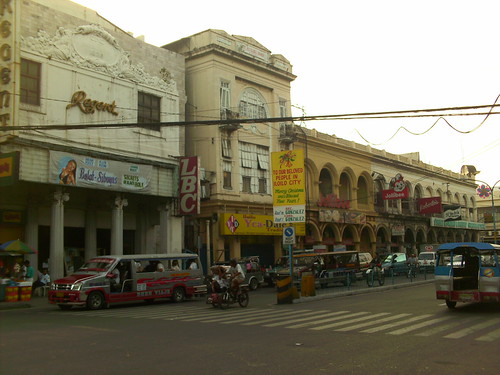
Let us move now! I know it is easier said than done, but let us not wait for these structures to dilapidate and fall a part before we act and save them.

Tuesday, August 21, 2007

The Ruins of Fuerza de San Pedro

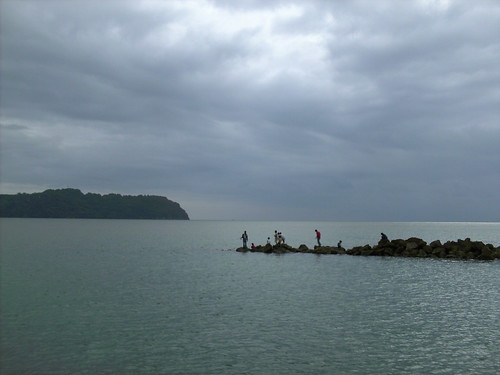
During the early Spanish period, La Punta or the downtown city was ocassionally attacked by Moro Pirates and Dutch Invaders. The Spanish government in Iloilo therefore initiated the construction of a fortress that will protect the thriving trading centre . It became one of the best fortresses in the country, a model of medieval Spanish architecture. However, the only problem with the fortress is that it was built close to the sea where it was too exposed to the strong waves. Because of this, the walls of the fortress deteriorated as time passed by.
After the devastating bombing of Iloilo, Fort San Pedro was completely destroyed. The only remnants of this known spanish fortress are the large pieces of limestone blocks which were used to build its once massive walls. Even if the century old fort was ruined, it was never removed from the hearts of every ilonggo. It has been converted into an esplanade where one can simply watch over the sunas it sinks behind the long silhoutte of Guimaras Island.

Wednesday, August 1, 2007

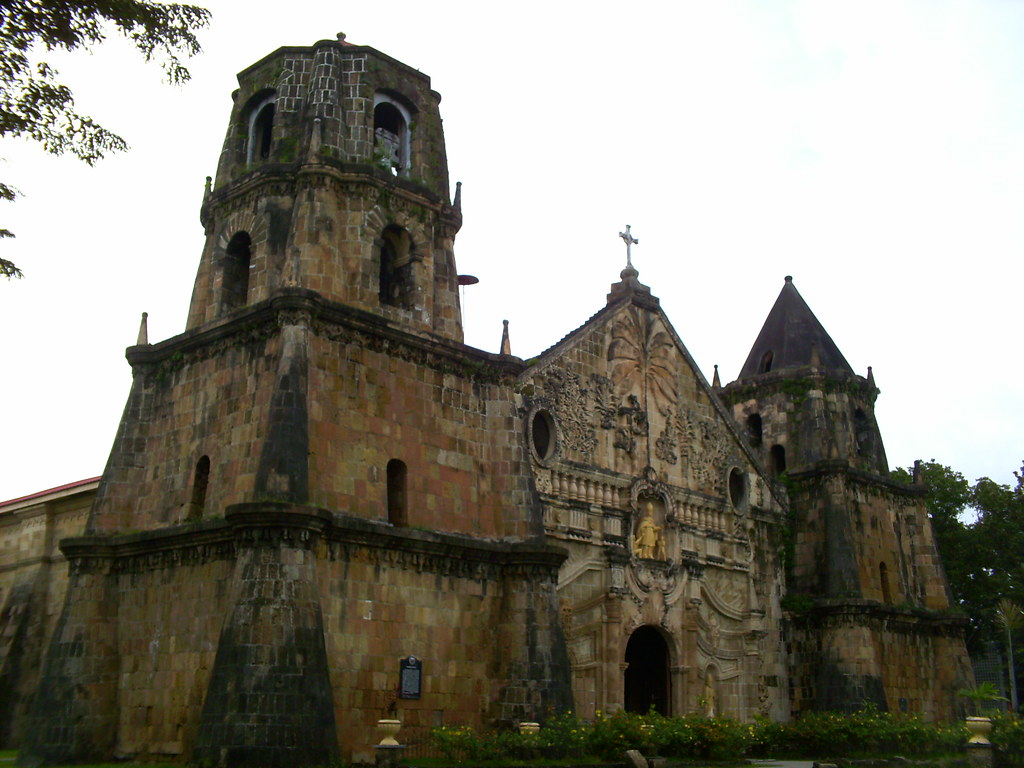
Miagao Church, A World Heritage Site

According to History, the present church of Santo Tomas de Villanova was the fourth one to be constructed in Miagao. Earlier churches were said to be burned by the Moro Pirates who ocassionally raided the seaside town. The poblacion was then transfered on top of Takas(Tacas) Hill where a fortress was built to protect the people from the raiders.
Aesthetically, the church isn't just any ordinary structure, it's an explosion of art and extraordinary beauty. The facade is said to be one of the best in the Philippines. Here, elements of Rococo, Churisguresque and Neoclassicism were combined to form a baroque masterpiece. It is noticeable that the artist used different types Filipino Botanicals supported by heavily carved balusters and intricare rococo carvings.
Aside from the facade, the unsymmetrical belfries contribute to the baroque roundness of the fortress. The pyramidal structure of the belfries are distinct features based from Mayan and Aztec Architecture. The church is now recognized as one of the UNESCO World Heritage Site.

Saturday, July 21, 2007

Convento de Santa Barbara

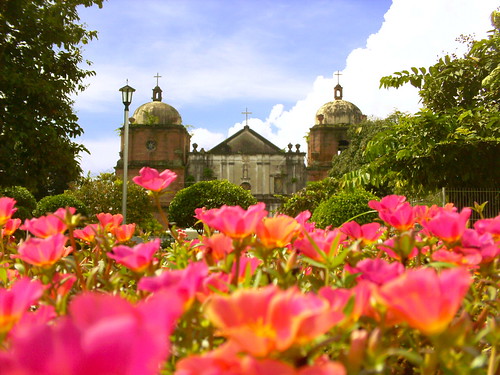
We Filipinos might associate Mudejaric Christian art with Cebu's Carcar Church but Iloilo's Santa Barbara Church is also a good example of Mudejar architecture. The facade of Santa Barbara church is perhaps a miniature of India's Basilica of Born Jesus while the convent's geometric designs and ornaments are similar with Southern Spain's Moorish inspired Churches. Mudejar architecture was widely used in Moorish Europe (Southern Spain and Morocco). It is a combination of both Classic and Moorish elements.
Historically, Santa Barbara Church was the headquarters of Iloilo's Revolutionary government which was headed by Iloilo's first provincial governor, General Delgado. The convent survived the threats of World War II but some parts were damaged after the 1948 tremor.
If you're itenary includes Sta. Barbara Church on the list, you wouldn't have any problem figuring out which jeepney to take. The Santa Barbara-Highway Jeepney passes UPV-Iloilo and SM city Iloilo and the Santa Barbara- Lapaz Jeepney routes through Lapaz and Jaro. Both jeepneys routes through Pavia. Santa Barbara shares a part of the Iloilo International Airport which is originally in Cabatuan, a neighboring town. It hosts the main access road towards the airport. The oledst golf course in South East Asia was also established in Santa Barbara, thus making it the recreation capital of Northern Iloilo.

Saturday, June 30, 2007

Cabatuan Church: Grandiose Elegance

Cabatuan church was built in 1734, a year after the town was established. The church was then built of light materials and the deficient source of stone quaries caused the delay of the construction of a larger temple. A hundred years later, Fr. Ramon Alquizar was assigned in Cabatuan as a parochial priest. He initiated the construction of a larger house of worship through baked bricks. Fr. Ramon Alquizar was the first one who introduced brick manufacturing in the province during the olden days, and his work of art, a masterpiece of varied architecture is our very own Cabatuan Church, or more commonly known as the church of San Nicolas de Tolentino. This church isn't just the first church to built of red bricks in the region, but it is the largest red brick structure in the Visayas as well. The later priest who undergone the finishing touches did fine work of transforming the church from a simple worship shrine to a grand basilica-like temple, thus the media reffered the church as 'the model of temples' since it was a mirror a majestic basilica inside and out. The church's structural architecture is similar with Latin American churches like that of Cuzco Cathedral in Peru and the church in Puebla, Mexico; however the design used on Facades are derived from Tuscanic architecture which is common in Southern Europe. Interiorly, the church is given a baroquial drift but still flowing with the balance of neoclacissm.

Wednesday, May 23, 2007

Law and Order

In the Early 1900's, the old Iloilo city hall grounds was once located in General Luna St. where the University of the Philippines is now located, in fact, the old city hall of iloilo is presently the University library of the UP campus.
This edifice which is Classical Roman in style is one of the city's prominent icons. The Facade portal of the library is flanked by two large statues named "Law" and "Order". These statues are greek in style and possess strong facial expressions which demand strength and power.


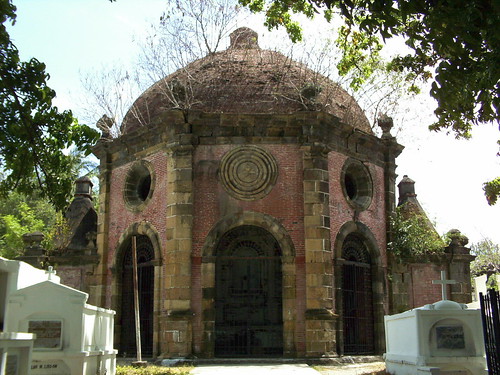
Miagao Cemetery Capilla

Indeed, Miagao Church is a popular tourist destination in the Province. It is one of the most photographed churches in the country and is one of the World Heritage Sites declared by UNESCO. However, aside from this 17th century church, Miagao also holds another historical treasure, the town's Hispanio-Filipino Cemetery and It's Romanesque Chapel.
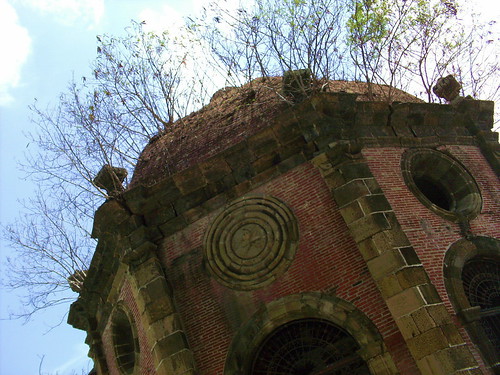
This is the only extant chapel in Western Visayas which still sports an 18th century brick dome. Built of baked bricks and yellowish coral stones, the chapel lies quietly on the foot of hill where the Poblacion of Miagao is located. Unlike the town's baroque church, the motiff of this chapel is simplicity, no intricate relief can be found on the facade except for a simple carving of the merged skull and crossbones.There are three entrances with roman arches each topped by circular windows. Ionic pilasters divide the facade into three and baroque finials crown the chapel's eight edges.
Upon aproaching the chapel, one may notice a ruined edifice on the left part of the cemetery. It is obvious that the edifice is a remnant from the 16th-17th century. Until this very day, no one knows what the structure was before it was ruined but it might be a church built before the present fortress church was finished.