Let's Travel and Discover the Secrets of ILOILO

WELCOME to Iloilo, A Province that dances with the rhythm of the past and the promise of the future. HALA BIRA!!!

Showing posts with label wonders. Show all posts

Friday, May 22, 2009

Janiuay Cemetery and the Arches of Heavenly Splendor

One of Iloilo’s most picturesque places was once included in the famed pages of National Geographic, this is the beautiful cemetery of Janiuay, the most artistic Spanish Colonial cemetery in the entire Philippines. Janiuay Cemetery is a beautiful example of Neogothic architecture. Tourist will be intrigued and awed by the architecture of this historical destination since the entire structure is perched on a hill and is approached by a grand flight of stairs that is not a very common arrangement for a cemetery. The main arch-gate has a pointed arc decorated by a cluster of ionic poles and simple rosettes. Two other arches flank the main arch-gate, however, the arcs of these gates are Tudor in style and are more ornate compared to the central gate. On the heart of the cemetery lies a Neo-gothic chapel. The windows of this chapel are amongst the most artistic renditions of Gothic Geometric style found in all of Iloilo.
The cemetery of Janiuay is amongst the country's greatest architectural achievements. It is a unique tourist destination because it showcases the artistry of Iloilo's golden era of colonial art.

Monday, November 5, 2007

The Cemetery of San Joaquin

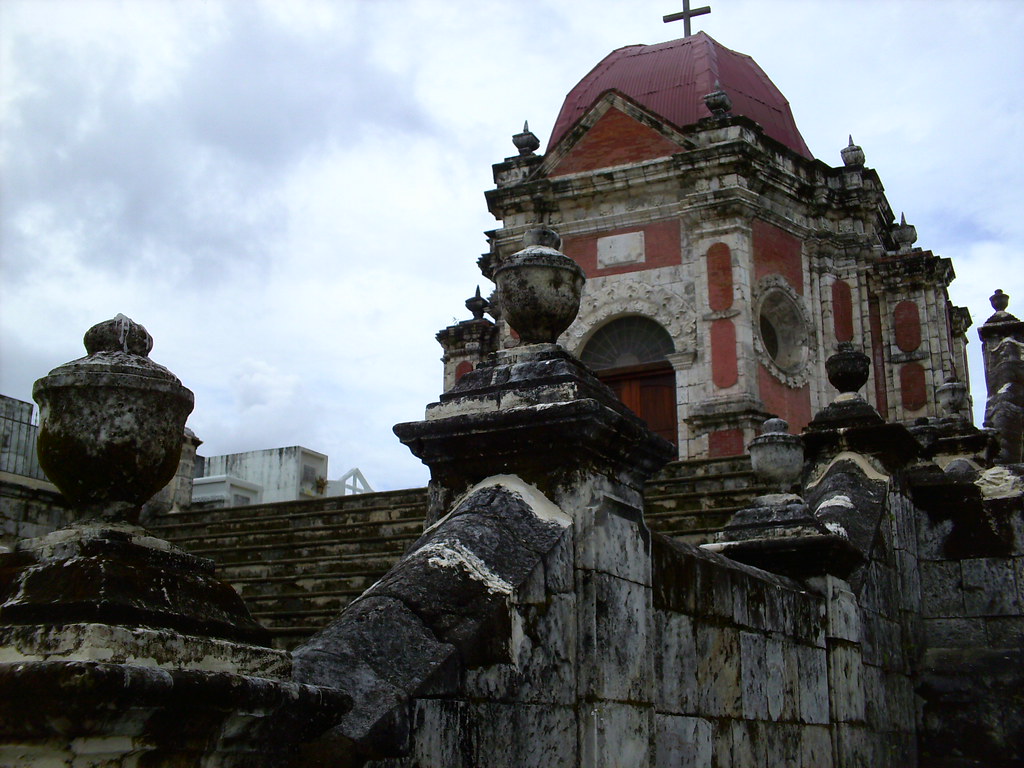
Legends say that there was once a mythical beast, half horse- half man, who goes to the shore to drink. The sight of this legendary creature frightens the people and thus, a shrine was built to ward off this magical spirit. This shrine is the 'Campo Santo' or the cemetery chapel of San Joaquin, an intricate oriental baroque structure that was built in the late 1800's trough hewn fossil stones and baked bricks.
Oriental art can be distinguished by the intricate use of floral motifs and curves, pointed finials that have Hindu influences all enhanced by the alternating colors of white and red.
Before reaching the town, a traveler might notice the crown like chapel looming over the cemetery. Delicate like a freed soul, the 'Campo Santo' is truly a heritage treasure that should be preserved for the next generation.

Wednesday, August 1, 2007

Miagao Church, A World Heritage Site

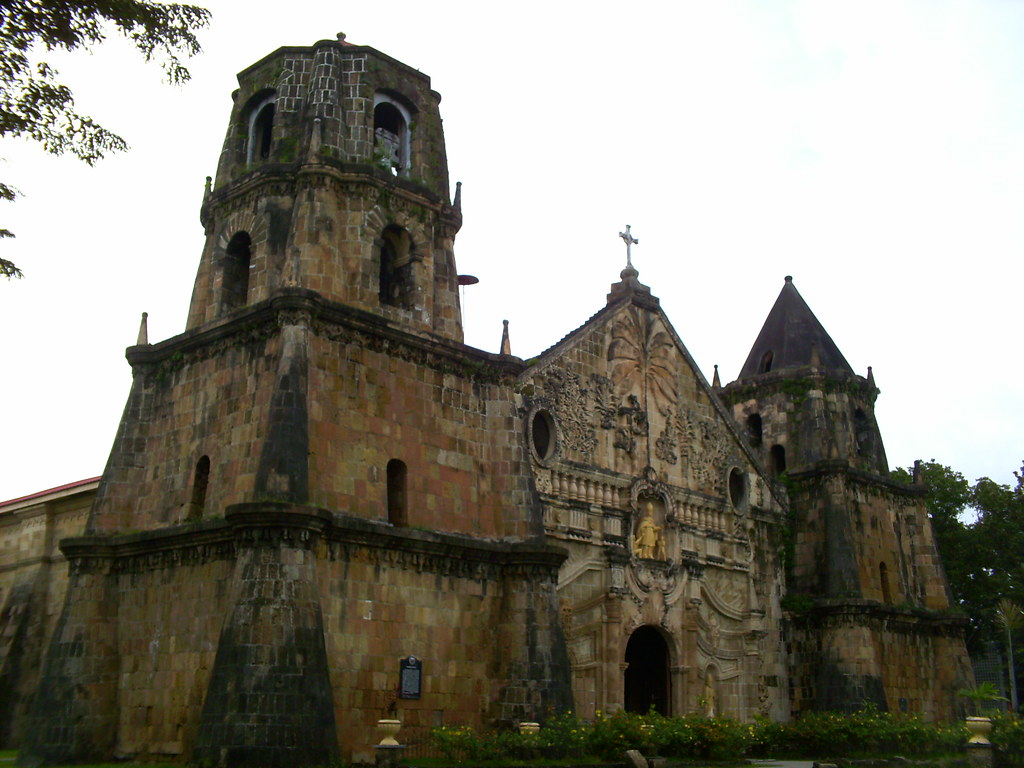
According to History, the present church of Santo Tomas de Villanova was the fourth one to be constructed in Miagao. Earlier churches were said to be burned by the Moro Pirates who ocassionally raided the seaside town. The poblacion was then transfered on top of Takas(Tacas) Hill where a fortress was built to protect the people from the raiders.
Aesthetically, the church isn't just any ordinary structure, it's an explosion of art and extraordinary beauty. The facade is said to be one of the best in the Philippines. Here, elements of Rococo, Churisguresque and Neoclassicism were combined to form a baroque masterpiece. It is noticeable that the artist used different types Filipino Botanicals supported by heavily carved balusters and intricare rococo carvings.
Aside from the facade, the unsymmetrical belfries contribute to the baroque roundness of the fortress. The pyramidal structure of the belfries are distinct features based from Mayan and Aztec Architecture. The church is now recognized as one of the UNESCO World Heritage Site.

Saturday, June 30, 2007

Cabatuan Church: Grandiose Elegance

Cabatuan church was built in 1734, a year after the town was established. The church was then built of light materials and the deficient source of stone quaries caused the delay of the construction of a larger temple. A hundred years later, Fr. Ramon Alquizar was assigned in Cabatuan as a parochial priest. He initiated the construction of a larger house of worship through baked bricks. Fr. Ramon Alquizar was the first one who introduced brick manufacturing in the province during the olden days, and his work of art, a masterpiece of varied architecture is our very own Cabatuan Church, or more commonly known as the church of San Nicolas de Tolentino. This church isn't just the first church to built of red bricks in the region, but it is the largest red brick structure in the Visayas as well. The later priest who undergone the finishing touches did fine work of transforming the church from a simple worship shrine to a grand basilica-like temple, thus the media reffered the church as 'the model of temples' since it was a mirror a majestic basilica inside and out. The church's structural architecture is similar with Latin American churches like that of Cuzco Cathedral in Peru and the church in Puebla, Mexico; however the design used on Facades are derived from Tuscanic architecture which is common in Southern Europe. Interiorly, the church is given a baroquial drift but still flowing with the balance of neoclacissm.

Monday, April 30, 2007

Santa Anna Church: Iloilo's Finest Gothic Church

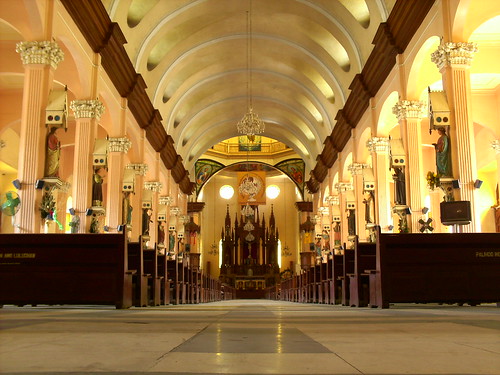
It seems that Gothic architecture is very rare in the Philippine archipelago. In Iloilo, we have a number of Gothic structures varrying from ancestral mansions, colonial era commercial buildings, schools and churches. The most popular amongst these attractions is the Gothic Renaissance Church Molo dedicated to Santa Anna.Aside from being a Beautiful Edifice, the church is very historical since the Country's National Hero, Dr. Jose Rizal once visited the church just to admire its Biblical-inspired beauty. It is noticeable that the church regards womanhood since female saints dominate the aisles heading to the altar. Exteriorly, the church is of Romanesque and Gothic architecture. The first and second level is decorated by tuscan and corinthian pilasters with roman windows decorated by geometric designs. The third level of the church is finely gothic in style proven by spirelets and gothic arch-niches and windows. Ineteriorly, the church is Romanesque but few elements of gothic architecture lifts its submissive features. Five wooden retablos are designed in Gothic architecture which gives the church a domination of Gothic- reniassance artistry.

Why I Love Molo Church? The spires of St. Anne church never failed to astonish me. It's grandeur is like no other and it's colonial environment complements its splendid millieu. The relaxing ambiance of the districts square burgeoned by enchanting trees gives the setting a classic medieval touch worth seeing.

Friday, February 23, 2007

Advertise Here

Do you want to earn more?
Do you want to increase your sales?
Do you want to increase traffic on your website?

If you want us to advertise your website or product, contact us at pacificleopard@yahoo.com and we will send you the details on how your website or product will be featured on Iloilo Onfoot.

We encourage you to send us an email if you are interested to our offer.
Thank you and God bless